Current News
January 26 2010
AMHE Relief Mission Report:
Mildred Olivier MD : Ophtalmology Group
Over the last two days, we have been submerged by administrative duties because the hospital resources got overwhelmed. We decided to let other physicians provide clinical care while we concentrated on human resources, medical staff support, and a whole range of other tasks ranging from welcoming new arriving groups to trying to dispose of dead bodies in the courtyard, patients who need new homes.
The amount of details is staggering and constant challenge to two physicians who have to come up with instant answers to the problems. There is often a backlog of patients who have been operated on and needs to move outside for further wound care or discharge. Then there are patients who are discharged and no longer have home to go to. There aren’t enough tents to house everyone including the staff. Now the medical staff are on the roof in hopes that it won’t rain. Astrid was in the OR all day long for the past two days doing eye cases, debridement, amputations and training to some of the incoming staff.
We are managing groups from Korea, Jamaica, Switzerland, Sweden, Hungary, Dominican Republic, Virgin Island, France and the United States. There are also Haitian physicians who came from the DR and locally and residents to help. There was even a lawyer who was the main OR technician before the international groups arrived the relive the Haitian physicians.
Now that things have been slowing down, there is more time for conflict and attempted resolutions. In the process we learned of other NGO’S who are supporting Haiti from different cities in the US.
This afternoon we had a large contingent of individuals coming from Michigan lead by Haitian podiatrist Dr. Mary Soledad Nelson and old friend of Serge. To our surprise our own Roland Balan our chiropractor in Chicago (AMHE member) was also in the delegation rendering her services to the hospital today. There trip showed the difficulties. They flew into the DR and tried to find transportation from there. On their way to Haiti, the leader of the group found out that her husband had a massive MI and dad. She flew back home while the group went on to PAP. They went to two health centers where they delivered medical supplies and arrived to the HCH. We were able to offer some members of their group to stay and try to organize the supply room. We knew we needed RN’s so we were happy to have them. They had a different modality of delivering their care.
We did notice that most of the decisions being made at the higher level, did not integrate the local medical and nursing staff. This is a complex issue since the visiting staff felt that the local staff was either absent or not willing to full participate in the effort. On the other side, the local staff felt that they were involved in the first line of defense and now that they were returning, they were being pushed out of the decision making process. The complexity of the issue is obvious to us who understands the need for visiting staff to speak the same language and share their common experiences and skills to get the job done. At the same time, we do also understand the necessity for the local staff and administration to be included at all levels so that they can learn develop new organizational skills, and medical and surgical skills as to other approaches of treating a particular problem.
Finally, the local staff has sustained emotional trauma as well and needs time to heal so that they can increase their ability to get back to somewhat of a normal life. The hospital is providing crisis management for the staff.
Dictated by Dr. Serge Pierre Louis.
January 25 2010
Progress Report
AMHE Relief Mission group
The Association of Haitian Physicians abroad deployed today to Port-au-Prince another contingent of Physicians and Nurses divided into two groups. I st group is leaving from JFK will arrive to Haiti via DR.
Jean Bernard Poulard, MD Team Leader, Georges Angus, MD, Team leader, Micheline Dole, MD, Julius Garvey, MD, Lionel Lefevre, MD, Calvin Mathieu, MD Emmanuel Hostin, MD, Gardy Joseph, MD, Anthony Boutin, MD, Gerald Augustin, PA M Ortelou, Boyer, RN, N. Carvallo PT, Ridgeley Ochs, John Williams, Carole Dubuche MD, Sabrina Jasmin RN
2nd group is leaving from Florida and should arrive early morning.Vladimir Berthaud MD , AMHE Team leader, Nissage Cadet, MD, Vascular Surgery
David Young MD, Surgeon Trauma and Critical Care, Gregory Dale-Casey MD, Surgeon Trauma and Critical Care, Jean Claude Desmangles MD, Pediatric Endocrinology, Vernat Exil MD, Pediatric Cardiology, Rubens Pamies MD from Nebraska U. Many nurses are included.
We are replacing individuals who had returned, but we clearly have sent so far a total close to 150 medical personnel ( FL and NY) to the center of this horrific disaster. We are grateful to Voluntary Ministries for using their planes free of Charge. We thank the members who have paid their own ticket to help Haiti.
Our AMHE Relief Mission team in the field in Port au Prince are Dr Pierre-Paul Cadet, Family Medicine, Maxime Coles, MD orthopedist, Dr Mildred Olivier, ophthalmologist and Dr Serge Pierre Louis, Neurologist. Dr Cadet is working with Haitian Red Cross to develop a better logistics: tent accommodations.. etc. If you need any of these above specialists, just call Dr PP Cadet at the General Hospital,+37896363. In the states, email us at amhereliefmission@amhe.org. pnacier@aol.com, eljerome@pol.net
To volunteer, please visit our website www.amhe.org
Dr Andre Vulcain a native of Leogane presents his report. Read it to understand why we need a long term commitment to Haiti.
I traveled to Haiti the same day the earthquake stroke. I landed in Port au Prince at noon time and my plan was to go the same day to Cap Haitien where we are operating our program . Because of the bad weather conditions in the northern part of the country, I decided to spend the night in Port au Prince and to fly the next day to Cap. I checked in the Visa Lodge Hotel, in the vicinity of the International Airport at about 2PM. I was in my bedroom at the hotel when the earthquake hit. Fortunately, for me personally, it was more of a big scare than real harm. I was emotionally shaken but physically fine.
The hotel was also fine . Overnight, various reports coming from outside of the hotel started to mention widespread destruction and many deaths. The next day, I actively looked for my immediate relatives and I toured the city to have an idea of the damages. My relatives were OK, even though my sister- in- law and my niece came out miraculously of the rubble of their heavily damaged home with some mild to moderate contusions. People on the streets were shell-shocked and some neighborhood looked like they had been bombed. Dead people were lying on the sidewalks and the valiant Haitian people, in an impressive demonstration of solidarity and compassion, were the first bare- hand responders without support or guidance from the authorities, trying frantically to extract some unfortunate victims from the rubble. Some of them died hours after been removed from the collapsed houses without a modicum of medical assistance.
On Post earthquake Day 2 , I ended up in Delmas 75 at my aunt’s house . I got the news of the UM hospital by the airport being set up, but I couldn’t reach them due to a lack of fuel in the vehicle I was using and the chaotic traffic on the roads leading to the airport .
I heard about an orphanage providing care to the victims at walking distance of where I was staying. I went there and I met two Haitian doctors who were working there since the morning (an orthopedist, Dr. Paul Pelissier and an anesthesiologist, Dr. Gabriel. They live in the neighborhood. Several Haitian medical students were also there to help. We quickly surveyed the place together and assessed the supplies and meds available. Fortunately, the orphanage looked pretty well stocked, by Haitian standards, in some basic supplies and 2 American missionary nurses offered their generous help. Some young Haitian volunteers came to help with the logistics . When I arrived, there were about 50 patients crowding the small courtyard of the orphanage and 2 rooms converted in Pedi wards. More patients were waiting outside desperate to get in the courtyard to have some medical attention. For the next three days we basically worked days in and days out and among other things, splinting and casting closed fractures , reducing dislocations of limbs , setting “creative” traction systems for alignment of displaced fractures, suturing wounds, debriding infected wounds and opened fractures, watching suspicious abdomens, providing IV and PO hydrations to those who needed it, as well as pain medication (mostly oral), performing supra pubic taps for patients with pelvic fracture and bladder retention (very difficult to find a foley catheter) .The owners of the orphanage were tending to the spiritual needs of our patients and providing much needed psychological support as well as food . Our team was, by luck, highly complementary and just after a couple of hours we were working effectively and efficiently focusing on the goal of helping our unfortunate brothers and sisters .
On Post earthquake Day 3 and 4 , we had to perform 2 amputations ( upper arm and forefoot for severely infected wound and sepsis ) .Those procedures were basically life- saving interventions for quasi gangrenous limbs. We used some basic suture kits and some godsend hemostatic clamps and suture materials . We had to use also some additional non surgical instruments to perform the procedures . I went fishing for them in the toolbox of my cousin where I was staying (saw etc…) .We make sure that all instruments used or to be used went to a three-stage process of sterilization ( bleach solution , boiling and bethadine bath ). We also performed two fasciotomies for compartment syndromes ( limb saving ). The anesthetist did a very good job providing pain control through regional blocks . Diclofenac IM worked miracle for pain control in the postop . My surgical training and experience that preceded my dedication to family medicine were definitely helpful in these particular circumstances.
Our major surgery patients (amputees ) were free of complications on their 3rd post op day with stumps showing signs of great improvement . We discharged them with antibiotics and instructions to report to another facility as our “clinic” was closing shop after we took care of about 100 patients .We had no death of patients who made it to our “ facility” .
On Post earthquake Day5 , I made a first trip to Leogane .We had received bad news from the area and I was especially touched by the situation . I found the city where I grew up almost totally destroyed with limited assistance after 5 to 6 days . My colleagues Dr. Guy Craan , an Haitian MD and a Public Health specialist had talked to me over the phone and made me aware of the situation and we decided to start a care unit there jointly with a team of Haitians and Cuban doctors already in the area. I went back to Port au Prince ( by that time I had some diesel for the vehicle I was using ) and I got a good amount of medical supplies from the UM hospital by the airport which we loaded in a pickup truck . Two haitian physicians joined our team . The post is up and running now as a multinational care unit at the entrance of Leogane .
I left Haiti 2 days ago and I am planning to return next week .
Recommendations for medical teams:
1- The following specialties are the most needed: orthopedists, general surgeons, anesthesiologists, family physicians and ID specialists, counselors for emotional support, trauma and emergency care nurses, infection control nurses.
2- Small and well balanced teams of physicians (3) and nurses(3) adjusted to the level of care of the setting, can provide efficient care, if supplies and proper logistics are available. It’s good to have some information on where the teams are going and tailor the teams based on needs .
3- Some temporary hospitals will keep operating for months . After the acute phase , there will be a need for other specialists ( internal medicine , pediatrics , psychiatrists , and rehab specialists ) to provide treatment for common illnesses, follow up for post op patients and attend to the needs of the amputees.
4- Port au Prince, Delmas, Leogane and Jacmel are places to consider. It’s possible to piggy back on existing units of care to enhance their ability.
Please visit our website www.amhe.org
Febuary 09 2009
For Immediate Release:
AMHE Foundation continues to help victims of tropical cyclones Fay, Gustav, Hannah and Ike through the Haitian National Red Cross Society
New York, NY – April 16, 2009 – Wracked by four successive hurricanes that destroyed entire towns, caused 800 deaths and more than $1 billion in damage last summer, Haiti is in dire need of help to alleviate the ensuing human misery. As always in time of disaster, AMHE Foundation – the philanthropic branch of the Association of Haitian Physicians Abroad – responded to the humanitarian call, joining hands with the Haitian Red Cross to carry out a program of water purification in the hope of preventing water-borne diseases in the flood-affected areas of the country where all sources of drinking water had been contaminated.
In December 2008, AMHE Foundation supported the Red Cross’ nutrition program by providing financing for chicken farming equipment and laying hens to provide eggs to undernourished children. Also, a program of micro-lending to women was begun in the region of Baie d’Orange. In this southern region of Haiti, over half of the children under five years of age suffer from chronic malnutrition and many have been stricken by Typhoid fever. A high protein diet ensures that over 200 children will be able to survive at least to their fourth birthday and their mother will be able to further support their family with the income generated by the sale of chicken eggs.
AMHE Foundation’s financial assistance also went a long way in the northwest region of Lavaud, by providing bean, corn and millet seeds to stricken population. It is our hope that such targeted intervention is necessary to alleviate the state of protein and carbohydrate malnutrition that is endemic in various parts of the country.
In January 2009, the Haitian Red Cross received a shipment of LifeStraws®, the personal water-purification system that turns dirty water into clean drinking water, as part of the AMHE Foundation Clean Water for Children Project. (According to UNICEF, more than half of all Haitian children under six suffer from waterborne diseases). AMHE Foundation provided these plastic straws, which filter water while drinking, to ensure that babies, children, pregnant women and others with fragile immune systems get safe water.
The need for continued collaboration with the Haitian Red Cross is evident, given the fact that the great majority of the population has no access to clean drinking water. We, therefore, appeal to your generosity and urge you to make a donation through http://www.amhefoundation.org in support of our programs.
Contact:
Association of Haitian Physicians Abroad (AMHE) Foundation
Dr. Paul Nacier
Pnacier@amhefoundation.org
http://www.amhefoundation.org
February 12 2009
I had a meeting with HUEH administrative group which Dr Hans Muller Thomas is the
Coordinator.I provided them a copy of the AMHE MSSP contract.Then I visited the HIV unit at the out patient clinic in HUEH. This program was written
by Dr Vladimir Berthaud, AMHE for MSSP .This program was executed and maintained by ITEC CDC, USAID, PEPFAR called President
Bush initiative. Latest Data are shown on the following graphs. Close to 3000 individuals are being tested per month People found positive are started on therapy. We should thank President Bush.


I spent three hours at the HIV center at the HUEH . Dr Nikki Lamothe, the director gave us an overview of the program.. AMHE has full access to the Database and should help improving the HIV care at that center. When the time comes we can write a paper . We started this project with MSSP in December 2005. We have a moral obligation to continue the work. Haiti is a difficult terrain,we know that. But the joy of doing something as little it might be , is greater than watching on the sidelines.
- Eric Jerome MD FACP
February 11 2009
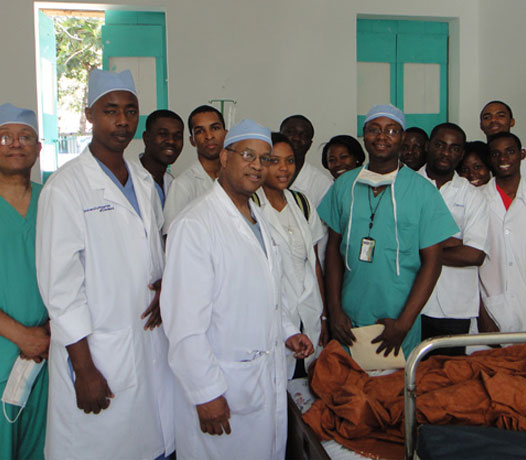
I joined Dr. Serge Pierre Louis(AMHE) of Rush Presbyterian Hospital Chicago, at the department of Medicine of HUEH where he was teaching Neurology. We need more volunteers like him.

I visited the dialysis unit. I spoke with Dr Abel, nephrologist. I met the chief of Medicine Dr Alix Lassegue. I promise to send him two endoscope instruments that I gave to Paul Nacier for insurance quality before shipping.
I spent a good hour and a half with the Minister of health Dr Alex Larsen. I presented him the good wishes of AMHE president Dr Christian Lauriston who could not make the trip.
He was very gracious to receive a representative of AMHE. I happen to be the Past president who two years ago signed a major contract of cooperation with the Ministry of Public Health ( MSSP). He is now in charge of the Department . We together read the agreement , line by line . He was certain such cooperation will continue under his watch. About our participation in the administrative meetings of HUEH.., he mentioned that structure has been eliminated. He has formed a board of three members to oversee the day to day operations at HUEH. We can be consultant.
We discussed the program of Rotation of Haitian Physicians at Brooklyn Hospital under SIMACT- AMHE .We stressed the fact that three anesthesiology residents, two OBGYN , one surgeon have completed the three months rotations in Brooklyn New York and back to the country. Special thanks to Dr Lesly Kernizant.
Quote « Dr. Bernadine MARCELIN
Résidente de 3e année en Anesthésiologie HUEH
Dr Jonathan Bazile Resident de 3e annee du service d` Obstetrique et de gynecologie HUEH
Je profite pour remercier le président de l’AMHE et les docteurs Paul Nacier, Eric Jérôme et Roosevelt Clerismé qui nous ont été très disponibles. «
Dr Marie Judith Jean Baptiste Resident en Anesthesiologie Ce fut une expérience très enrichissante. J’ai eu l’opportunité de travailler à la fin de mon stage avec presque tous les médecins et infirmières anesthésistes de l’hopital où j’ai pu maitriser de nouvelles techniques indispensables pour compléter ma formation.””
We explained to Dr Larsen that we have respected the terms of the contract in trying to open an acute unit, not a chronic unit but an acute dialysis unit at Justinien hospital according to the wishes of MSSP. Close to 30000.00 dollars of material and equipment are sitting in the hospital warehouse in Cap Haitien pending completion of the Cardiac Renal Unit at the institution by MSSP. He called Dr Coq Director of Justinien through Ariel Henry to insure contact be well established. I subsequently spoke with the chief of Medicine Dr Dany Dugue Coq for follow up.
Present at that meeting were Dr Ariel Henry, Dr Robert Auguste prior chief of staff, Dr Michaud
I had a follow up meeting with Dr Gabriel Thimothee to keep him abreast of the latest development.
- Eric Jerome MD FACP
February 10 2009
I attended an inauguration of the new Medical facility of Bill Pape at Chateaublond, region of Tabarre.
This institute of infectious diseases GHESKIO-IMIS consists of Warren D Johnson Jr Medical Center and Laboratoire Rodolphe Mérieux. More to be added later on. Dr Warren Johnson from Cornell University was elated to have one part of this complex named after him for his thirty years of working off and on in Haiti.
Warren D. Johnson, Jr said. “Thank you GHESKIO and Haiti for this extraordinary honor – and thank you Bill for your generous remarks. When I learned of this honor I was overwhelmed – seeing the medical center today hasn’t decreased that feeling.
I met Bill Pape when he was a medical student in 1971 – he had a vision – to return to Haiti with his Cornell training and to make a difference – Bill has indeed made a difference.
The GHESKIO team has persevered through adversity – and thrived. We were told many times over the years that it couldn’t be done – let alone be done in Haiti but it was done – often for the first time anywhere, by GHESKIO, in Haiti –
…GHESKIO outgrew its original facilities – but it now has this beautiful new clinical and laboratory complex to continue and expand its work.”
I met a few officials of the USAID and CDC. Dr Anna Lycos was present as well US, France and Canada Ambassadors. Our colleagues Drs Gerald Lerebours, Gabriel Thimothee attended the ceremony. Dr Bill Pape was ecstatic to see a realization of a dream.
Dr Jean William Pape dixit : “ Warren,… you were instrumental in the creation of GHESKIO. You believe strongly that without health poverty cannot be beaten and economic development cannot succeed. Most importantly you stood by us in good times (there were not many) and in bad times. You made us prepare a plan to create the future rather than responding to it. The Warren D. Johnson Jr. Medical Center standing in front of us is creating the future…..
C’est l’occasion pour moi de féliciter nos nombreux cadres et employés qui ont fait leur ce standard et ce label de qualité. Je leur demande encore de repousser les limites du possible pour qu’ensemble nous puissions atteindre le parfait.
- Eric Jerome MD FACP
|